
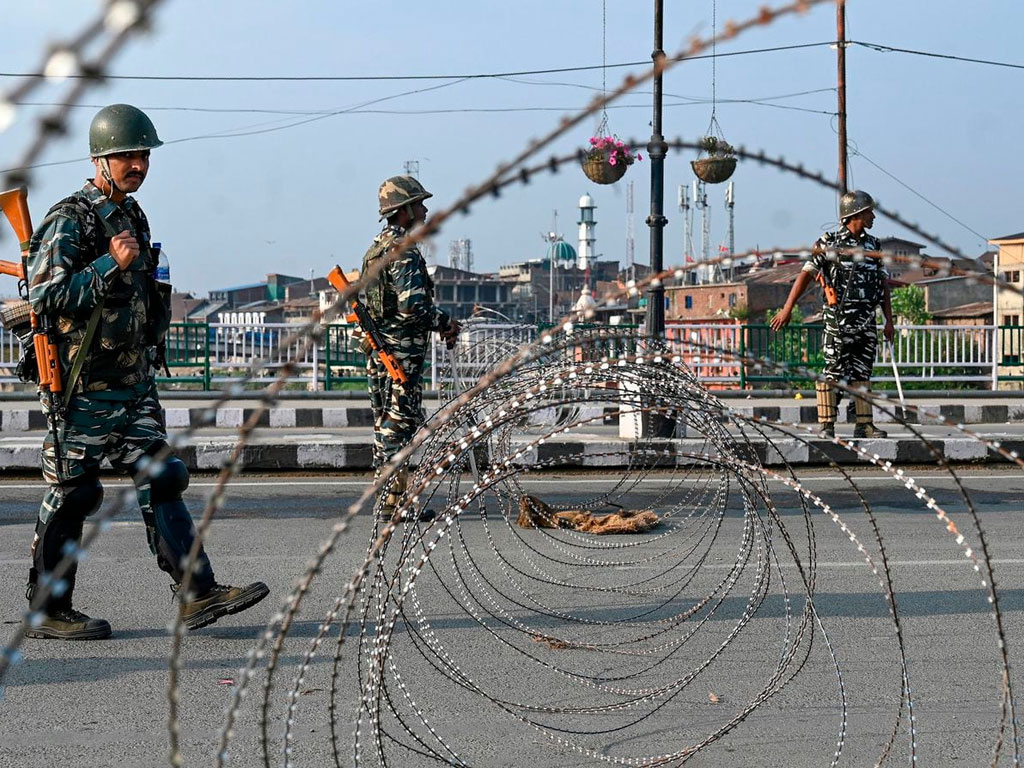
The jailed leader of All Parties Hurriyat Conference Syed Ali Shah Geelani has somehow managed to send out a letter with a five-point "programme of action" urging the people in Occupied Jammu and Kashmir (J&K) to continue to resist "naked Indian brutality with courage". And recalling "how during the recent events in Jammu and Kashmir (the local) police forces were disarmed and the entire command given to the Indian army and paramilitaries," he exhorted administration and police officers to "stand up and protest" against the humiliation inflicted on them by New Delhi. The letter also made an appeal to "the people of Pakistan, their leaders in particular, and the Muslim Ummah in general, to come forward at this critical juncture to help the besieged people of Kashmir."
People's resistance continues despite curfews, crackdowns and mass arrests. Pakistani leadership have taken all possible steps to draw international community's attention to the ongoing bloody repression and of an impending genocide in Occupied J&K. On its request, alongside China's, the UNSC discussed the situation arising out of revocation of the disputed region's special status. Prime Minister Imran Khan and Foreign Minister Shah Mehmood Qureshi have regularly been in touch, by phone, with leaders of major countries as well as the non-permanent members of the UNSC to apprise them of the gross human rights violations and the threat the situation poses to the peace and security of this region. Unfortunately, as regards the Muslim 'Ummah', the less said the better. Whilst the clampdown and attendant atrocities in J&K persisted for the third consecutive week, leaders of the Arab Gulf states decided to fete the tormentor of their Muslim brethren: India's Muslim-hating Prime Minister Narendra Modi. Two days before Geelani's open letter surfaced, the UAE bestowed Modi with its highest civilian honour, the Order of Zayed. The next day, he arrived in Bahrain - on a first visit by an Indian prime minister to the sheikhdom - where he was awarded "the King Hamad Order of the Renaissance" in what was described as recognition of his efforts to strengthen bilateral ties between the two nations.
The UAE had announced the award back in April. Still, the least expected of the two Arab states was to leave the ceremony to another time, if not abandon it altogether. In fact, in an open letter to the UAE Crown Prince Sheikh Mohammed bin Zayed Al Nahyan, a British Labour party MP, Naz Shah, had asked him to "reconsider giving such an award, not only because the majority of the Kashmiri people share the same faith as you, but because we have a duty as human beings to stand up against the disregard of human rights and evil." But moral and humane considerations went by the board. True, the Gulf Arabs have strong economic interests to protect and promote. Huge investments have flowed in either direction. India is world's third largest importer of crude oil. Some 3.1 million Indians, from labourers to multi-billionaires, work and/or have bought properties in the UAE. But then it is also true that it is as important for that country to maintain these relations as it is for the UAE and other Gulf states. Showing some concern for the suffering of Kashmiri people would not have cost anything to Muslim Ummah brothers. Prime Minister Imran Khan, while addressing the nation, has made it clear that Pakistan will go to any length in supporting the cause of the Kashmiris and expose India's gross abuse of human rights in Occupied Kashmir, even if it has to do it alone.