
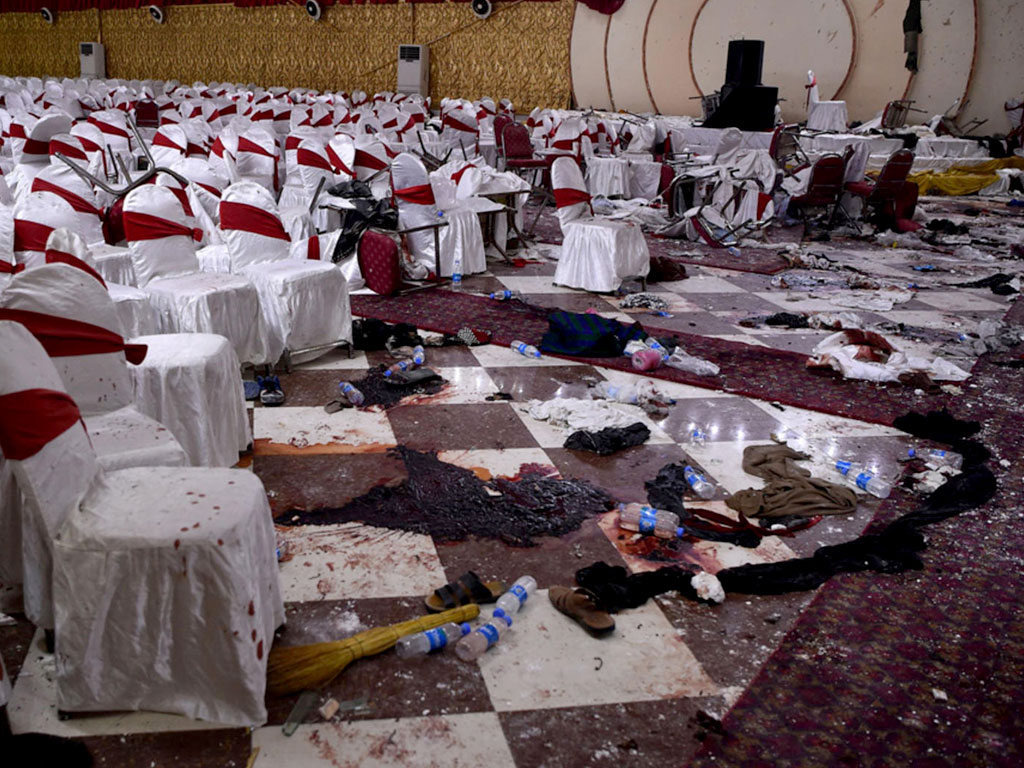
In the context of a peaceful Afghanistan the incidents that happened last week merit serious consideration because they tend to suggest that even after 18 years of war, peace in Afghanistan remains an ever-receding mirage. Of these the latest is the suicide-bomber attack on a wedding party in Kabul on Saturday, killing 69 people. While President Ashraf Ghani says the Taliban don't 'escape responsibility' for this horrific attack and Taliban promptly disowned it, the Islamic State (ISIS) claimed responsibility. In a statement in Arabic, it claimed the attack was carried out by its suicide-bomber named Abu Asim Al-Pakistani. And expressing its heartfelt condolences to the victims of Pakistan said "terrorism is a common enemy for the entire region and must be defeated together". A day before, on Friday, in a mosque near Quetta four people, including a younger brother of Taliban chief Haibatullah Akhundzada, were killed and many injured. There was no claim of responsibility for this remote-controlled bombing. The Taliban said it would not derail peace talks with the United States, while the guard of the mosque, who is said to be a former employee of the Afghan security force, was taken into custody. As it happened, the United States' self-assurance of clinching the peace deal with Taliban seems to have weakened. President Trump says "Afghanistan cannot be a laboratory for terror. We're looking at Afghanistan. We are talking to Afghanistan, both the government and also talking to the Taliban, having very good discussions. We'll see what happens ... We'll decide whether or not we'll be staying longer or not". As to what is new, but not entirely, about the ongoing Afghan imbroglio, the US peace envoy Zalmay Khalilzad also gives an indication: "We must accelerate the Afghan Peace Process, including intra-Afghan negotiations. Success here will put Afghans in a much stronger position to defeat ISIS (IS)."
Put together these incidents and comments indicate that while the Afghan government accuses Taliban, with whom the United States is closing the ranks, the Islamic State's so-called Asim Al-Pakistani carried out the massacre in Kabul. Guess, who would like to blur Pakistan's sharp focus on the ongoing apocalypse in India-Held Kashmir. There are wheels within wheels, but the end sufferers are the Afghans and the Kashmiris. How to secure lasting peace in Afghanistan, the emerging trail of events does not portend a peaceful future for the people of Afghanistan anytime soon. If in the past Afghanistan was a 'graveyard' of invading armies the present Afghanistan is a graveyard of its own people. It is the US-led coalition forces which came there in the name of securing Afghans against extremist Taliban regime. Now the same force is looking for the way to leave Afghanistan. And, it must leave, but not the way its combat forces left Iraq. Retired General David Petraeus, the then commander of US forces, wants the Trump administration not to 'repeat the mistake of total withdrawal' from Afghanistan, and thus open door on ISIS's regional affiliates. To this, Senator Lindsey Graham adds: "If we leave Afghanistan without a counter-terrorism force, without intelligence-gathering capabilities, ISIS will reemerge, al-Qaeda will come back, they will occupy safe havens in Afghanistan, they will hit the homeland, they will come after us all over the world". The creeping uncertainty about the Afghan future may be of some worry to the United States and others, but not as alarming as it is to Pakistan. No other country has suffered the collateral damage, mainly in terms of losses of life, of the Afghan war as Pakistan. But with India wrecking havoc in Muslim-majority Occupied Kashmir and its ministers threatening to 'liberate' Azad Kashmir, Pakistan may not remain focused on Afghan peace prospects as it has been till very recently. Perhaps, the Kabul wedding incident is the work of those who want Pakistan to remain focused on developments on its western front instead of looking at what is happening on its eastern front. Rightly then one may conclude that the rise of ISIS-conducted upsurge in violence in Afghanistan tends to divert world attention from the killing fields of Kashmir. Since uncertainty pervading the Afghan landscape, peace is still not in sight. But it got to return to Afghanistan, and that would be only when all stakeholders leave this to the people of that country. The reality on the ground says the Taliban may be victors on the battlefront, but to be rulers in Kabul they need to win the support of the Afghan people.