
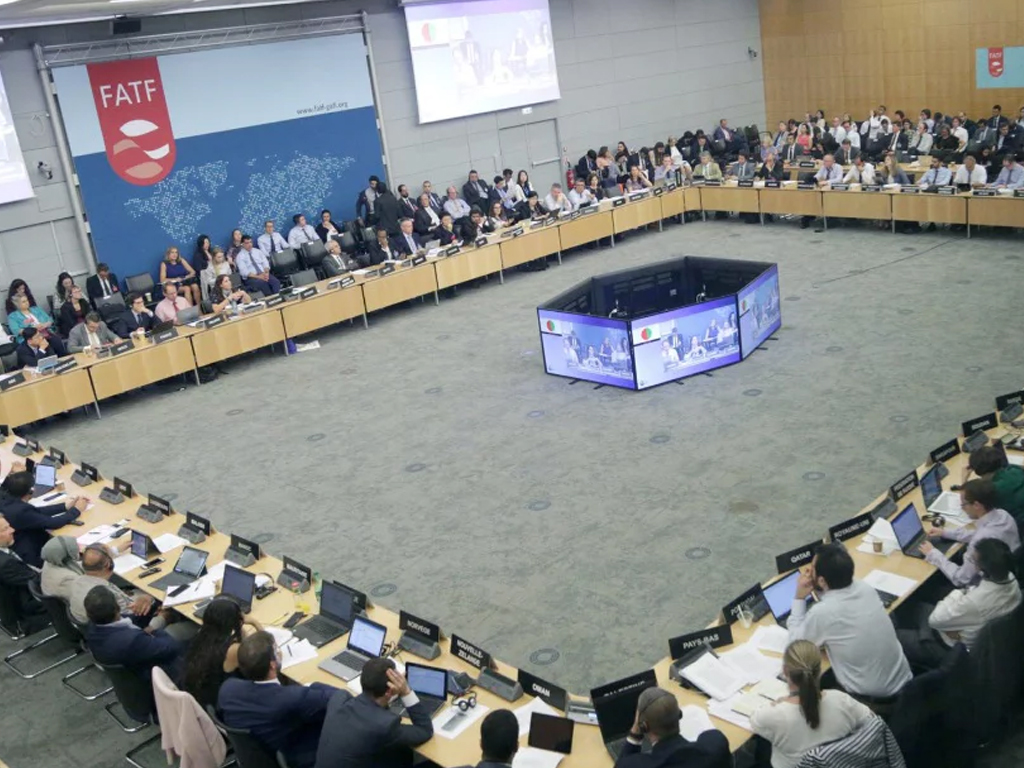
On 22 February, the Financial Action Task Force (FATF) uploaded on its website its serious concerns on Pakistan's inability to "demonstrate a proper understanding of the Terror Financing (TF) risks posed by Da'esh, AQ, JuD, FiF, LeT, JeM, HQN, and persons affiliated with the Taliban." The FATF further maintained that "given the limited progress on action plan items due in January 2019 FATF urges Pakistan to swiftly complete its action plan, particularly those with timelines of May 2019." In other words, Pakistan remains on the grey list with the undesirable prospect of being placed on the black list that would seriously compromise the government's ability to attract foreign investment and/or raise revenue from tourism.
The FATF's ruling was made subsequent to Pakistan's case being presented by a 12-member Pakistani delegation led by Secretary Finance on the 5th of February 2019 with other members of the delegation, including representatives from the State Bank of Pakistan, National Counter Terrorism Authority, Federal Investigation Agency, Federal Board of Revenue and Financial Monitoring Unit. The delegation's perception of success in convincing the Paris-based body that Pakistan was complying with the time-bound agreed action plan, shared with the media subsequent to their return, was therefore completely at odds with reality; clearly the team failed to convince Asia Pacific Group on Money Laundering (APG) that Pakistan had adopted, implemented and enforced internationally accepted anti-money laundering and counter-terrorist financing standards as set out in the FATF which no doubt accounts for the 22 February ruling. Critics of the PTI maintain that the focus of the government and associated ministers remains on procuring loans from "friendly countries" as well as negotiating a bailout package with the International Monetary Fund and civil servants, with little understanding of the vision of the new government in this respect, made a hash of the meeting. Had senior elected members of the administration taken the trouble to attend the meeting, perhaps they would have been able to convince the APG that the new government is committed to meeting all the time-bound conditions contained in the action plan. Former finance ministers, including Ishaq Dar and Dr Miftah Ismail as well as the Caretaker Finance Minister Dr Shamshad Akhtar, personally led the Pakistan delegation in an attempt to convince AGP/FATF that the country was fully engaged in meeting its obligations in this respect.
Be that as it may, the FATF did acknowledge that Pakistan had "taken steps towards improving its AML/CFT regime, including operationalising the integrated database for its currency declaration regime... [but added that] it should continue to work on implementing its action plan to address its strategic deficiencies." Disturbingly, the 10 strategic deficiencies remain largely unchanged from previous meetings and include mention of "cash couriers", "demonstrating that Terrorist Financing prosecutions result in effective, proportionate and dissuasive sanctions and enhancing the capacity and support for prosecutors and the judiciary," "demonstrating effective implementation of targeted financial sanctions (supported by a comprehensive legal obligation) against all 1267 and 1373 designated terrorists and those acting for or on their behalf, including preventing the raising and moving of funds, identifying and freezing assets (movable and immovable), and prohibiting access to funds and financial services," "demonstrating enforcement against TFS violations including administrative and criminal penalties and provincial and federal authorities cooperating on enforcement cases," and "demonstrating that facilities and services owned or controlled by designated person are deprived of their resources and the usage of the resources." In this context, it is relevant to note that in spite of rhetoric that the Khan administration has zero tolerance for money laundering and terror financing yet while cases are being registered by law enforcement agencies yet prosecution remains very weak and the plea bargaining is allowing the bulk of the money to remain with the accused.
To conclude, the government needs to focus on legal measures required to ensure that Pakistan meets all obligations by May this year, and begins the process of strengthening institutions through legislation that would require a less divided parliament, and strengthen the prosecution that continues to exhibit little or no capacity.