
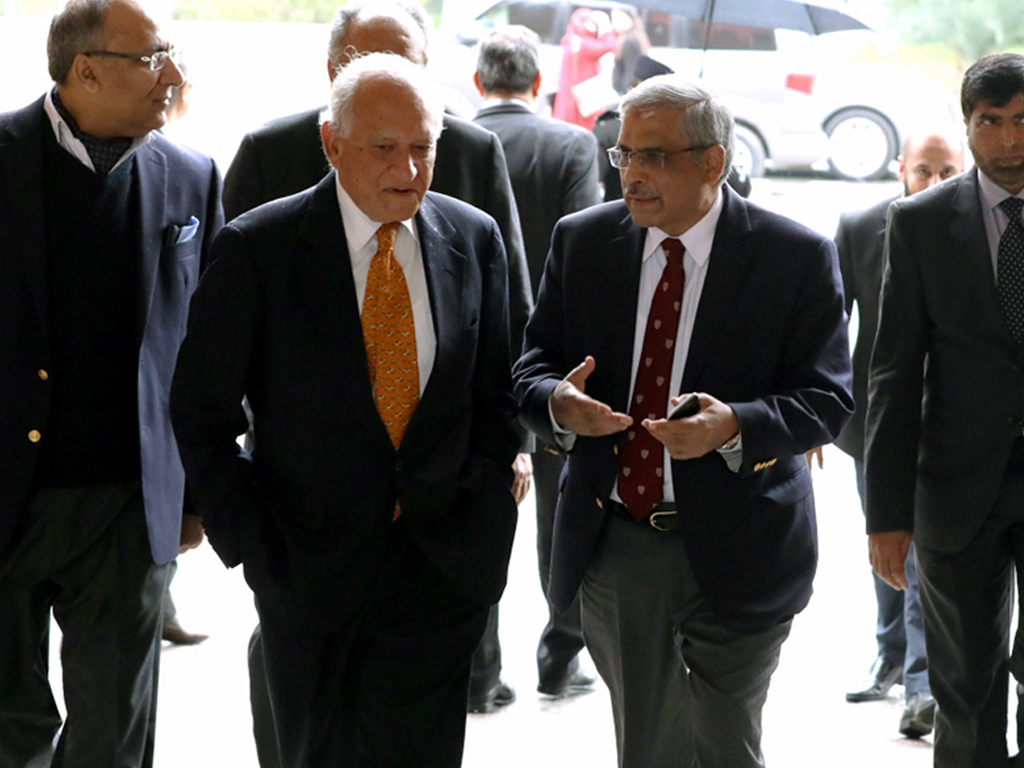
It is sad to see that sometimes high public officials make claims that are at variance with ground realities. Talking to media after a ceremony held at the Lahore University of Management Sciences (LUMS), the State Bank Governor, Tariq Bajwa is reported to have stated that the country has come out of the financial crisis with the help of friendly countries and the economy has been set on the right path. The uncertainty in the economy has ended and the country is now able to meet all the economic challenges. Current Account (C/A) deficit is the real cause of concern for the new government led by Imran Khan who visited friendly countries like China, Saudi Arabia, the UAE, Malaysia and Turkey to seek investment and managed to get financial help to bridge the external sector gap. The government has prepared a plan to eliminate the C/A deficit and negotiations with the IMF are in progress for a package to minimize it. The government has also not crossed the borrowing limit from the SBP and it has borrowed Rs 3 trillion from the SBP and returned Rs 2 trillion to the commercial banks. This is a policy to keep the scheduled banks liquid so that private sector can borrow more from the commercial banks. The private sector borrowing has more than doubled from 1st July to 8th February, 2019 to Rs 571 billion from Rs 264 billion in the same period of last year. Cases involving Rs 600 billion are pending in the banking courts and capacity building is being developed to deal with the huge number of pending cases for quick decisions. The policy to depreciate the rupee has been adopted to reduce the trade deficit which is the main reason for high C/A deficit.
The observations of the Governor, SBP, indicate very clearly that financial position of the country has been stabilised, the economy is already out of the woods and poised very much for recovery. This, in our view, is contrary to the facts and the SBP in its own documents and at various other fora has been saying this all along. For instance, to say that the country is now out of the financial crisis and the economy is set on the right path is only partly true and conveys a false sense of victory before the fight has even begun in earnest. It is good to see that the immediate crisis in the external sector has been averted for the time being with the help of friendly countries, but the situation in the foreign sector continues to be precarious and nowhere near the point that can be termed satisfactory or sustainable. The fact of the matter is that exports of the country have yet to increase substantially, imports need to be reduced further and financial inflows including foreign remittances have to be enhanced sharply in order to have a sustainable position in the external sector. There is of course some reduction in C/A deficit in the recent months but the reduction is far too small to instill a degree of confidence in the solvency of the country. Foreign exchange reserves of the country at present are hardly able to finance two months of imports and the confidence of foreign investors could be gauged from the fact that FDI in Pakistan that was already at a very low level has plunged further by 18 percent during the first seven months of the current fiscal year compared to the same period of last year. Two famous world rating agencies have also downgraded our ratings.
Some of the other macroeconomic indicators also continue to be gloomy. Fiscal deficit of the country is likely to reach 6.3 percent of the GDP during FY19 due to lower tax receipts and high current expenditures. The fiscal target of 5.1 percent for the present year is likely to be missed by a wide margin despite a sharp cut in PSDP and government's austerity drive. The country's indebtedness is increasing due to huge fiscal and C/A deficits and there is no hope that it can be brought down anytime soon. Inflationary pressures are clearly emerging and accentuating in the economy. The Governor has appreciated the move to shift government borrowings from the scheduled banks to the SBP but such a policy would be highly inflationary and in no way will it yield a better fiscal outcome. It is good to see that the State Bank is trying to develop capacity building to deal with the huge number of pending cases in the country but such a policy, even if implemented today, would take a long time to bear the desired results. It is quite possible that the Governor SBP may have tried to give a positive spin to the unfolding developments at LUMS for public consumption and encourage the investors and other stakeholders to look at the economy in a positive way. Such a perception is strengthened by the fact that the State Bank, in its MPS released on 31st January, 2019, had given a very pessimistic view about the twin deficits and the inflation prospects and called upon the government to generate conditions for stability and sustainable growth.