
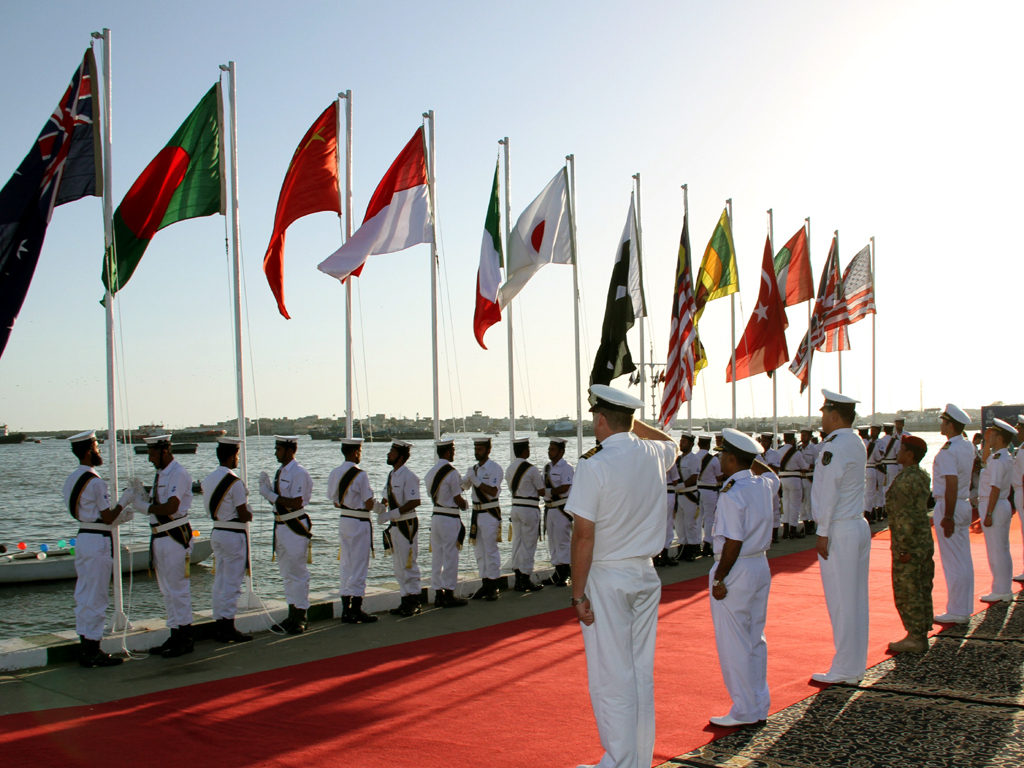
A peaceful, secure and tension-free Indian Ocean region is in Pakistan's lingering strategic interest, as it was in the 1980s when India acted as a proxy of the then Soviet Union. And, now as the United States returns to the Indian Ocean region with a view to checkmating China - which is said to be turning into a soft superpower - India acts as a proxy of the United States. In today's Indian Ocean there is the big power rivalry to acquire commercial ports and military facilities. Pakistan won't like to act as anybody's proxy, though it does have substantial stakes in a secure and tension-free Indian Ocean. As Admiral Amjad Khan Niazi said on the eve of five-day multinational naval exercise Aman-2019, Pakistan's extraordinary dependence on the seas for trade, the CPEC project and its strategic location astride the global energy highway warrant that this body of water remains safe and crime-free. Rightly then Pakistan played host to the Aman-2019, which is sixth in sequence and attended by 45 countries. If anyone from the region was missing from the exercise it was India, essentially because the Aman-2019 doesn't fit into its lasting dream to turn the Indian Ocean into a huge 'Indian lake'. Also possibly, India's naval strategists mistook this exercise for some kind of get-together against it and decided to stay back. While, on the other hand, the main purpose of this exercise is to provide a forum for understanding each other's maritime concepts and operational cultures and come up with ways and means to combat common threats at sea such as piracy, terrorism and the climate change. Not being country-specific but worldwide the Aman-2019 offered an opportunity to develop and practice common tactics, procedures and mechanics to deal with these threats. Admiral Niazi pointed out: "Overall, the Aman exercise is about bridging gaps and making it possible to operate together in pursuance of shared objectives." It should be of interest to note that Pakistan is the largest regional contributor to the Regional Maritime Security Patrols (RSMP), which has to a great extent curbed the menace of piracy, helped protect vital choke points and ensured good order at sea.
If the Aman-2019 provides an opportunity to look into the possible threats to international trade and security at sea it also brings under sharper focus the host country's stakes, both strategic and commercial, in a peaceful sea that washes its shores. President Arif Alvi was spot-on when he in his opening speech stressed the importance of "blue economy and effective use of ocean resources" as key to Pakistan's future. Undoubtedly, Pakistan's maritime territory, including continental shelf, is rich in fossil fuels and seafood, but not much is in evidence suggesting that anything meaningful was done to exploit these resources. Hopefully, that may not be the case anymore; a Chinese geological survey ship is surveying the area. But that said there can be no discussion about the Indian Ocean without India being referred as the bully on the block. The Chinese-assisted Gwadar seaport is a thorn in its side, as well as of the United States. The Indo-US combine is busy establishing its writ, both political and military, at almost all chokepoints of Northern Indian Ocean. Not only has it taken over operations of a berth in the Iran's Chabahar port, it has also established its bases in Djibouti, Oman, Sri Lanka, Maldives and at the mouth of the Malacca Strait in Sumatra. It is India that has upped its anti-Pakistan ante by inducting sea-based nuclear weaponry in the Indian Ocean. Pakistan "has to have" sea-based deterrence to maintain strategic balance. That deterrence is in the form of Babur-3 nuclear-capable submarine-launched missile (SLCM). As a matter of policy, Pakistan has developed the cost-effective solutions to take care of India's hegemonic designs on land, air and sea.